Why an attractive market is not the same as a winnable one

In 2008 I joined a small but highly regarded UK cybersecurity specialist. Twelve months later, a US rival sitting in the top right of the same Gartner Magic Quadrant acquired us to give itself a footprint in Europe. Overnight, our UK business of around $5M a year became everything the company had outside North America. The flag was planted, and the next question arrived quickly: where next?
Answering that question became a large part of my job. Over the following years, I was one of the leaders who grew that international business across Europe, the Middle East and Africa (EMEA) and Asia Pacific to more than $150M in annual revenue, a thirtyfold increase. Along the way, I sat in a great many management meetings about the next market.
Those meetings followed a familiar pattern. The slides showed two numbers: total addressable market (TAM) and compound annual growth rate (CAGR). France and Germany were the obvious prize, the largest markets in Europe with the highest growth, and a large TAM with a strong CAGR was taken as the case for entry. What was missing was the case that matters: why we should enter, and how we would win share once we were there.
Our first move into France began with a single, very large deal. The deal was real and the growth was real. Neither told us how French organisations bought, whom they trusted or who we would be competing against. We learned those lessons in market, at our own expense, and every entry that followed was stronger for them.
Chasing it was the right instinct. Good businesses follow demand. But a big deal and an attractive CAGR are reasons to examine a market, not a strategy for winning it. The principles apply wherever you are going, and the work below should be done before anyone books a stand at a trade show, signs an office lease or hires a country manager with a target and a blank sheet of paper.
1. Dust off the theory
My university years were not, it is fair to say, a model of academic discipline. But somewhere between the student union and the library, the strategy models stuck, and they have earned their keep many times over. I see too little of them from marketing teams today, which is a shame, because they were built for precisely this decision.
- PESTEL (political, economic, social, technological, environmental and legal factors) covers what you cannot control: regulation, procurement rules, politics, economic conditions and attitudes to foreign suppliers. You cannot change any of it, so understand it before you commit.
- Porter’s Five Forces shows the structure of the market: how competitive it is, how high the barriers to entry are (first for you, then for whoever follows), how much power buyers and their partners hold over access, and whether local service providers offer a cheaper alternative.
- The GE-McKinsey matrix brings it together. McKinsey built it for General Electric in the early 1970s to decide where to put capital across a sprawling portfolio of businesses. It plots market attractiveness against your ability to win, and the answer to a market entry question sits where the two meet.
Nobody has ever been promoted for a well-coloured nine-box grid. But filling in both axes honestly is the whole job, and the rest of this piece is how to do it.
2. How attractive is the market, really?
TAM and CAGR are where attractiveness starts, not where it ends. PESTEL and Five Forces add the structure. The rest comes from people with boots on the ground.
Speak to those who sell there. Start with your own network. The telemarketing, public relations (PR) and demand generation agencies I already worked with either operated in the new market or knew who did, and they were speaking to its buyers every day. They knew who bought, how they bought and what it took to sell to them, because they were doing it. Add former colleagues, customers, partners, local analysts and buyers (including competitors’ customers), and you will learn more in a few weeks than any research report can tell you.
Understand how buyers behave. Language and time zones are the easy part. The real differences lie in who is involved, how much detail they expect, their appetite for risk and where they turn for advice. German buyers I worked with expected depth, detail and often a pilot before a larger commitment. In France, relationships and trusted recommendations carried far more weight. Research consistently shows that buyers do most of their research, and form most of their opinions, before they ever speak to a sales representative. Most of their judgement about you is made before you are in the room.
Find the buyers, not the market. TAM looks good on a slide. What matters is active TAM: the accounts that are in a buying cycle now, and whether you can identify them while they are. A useful rule of thumb is that only around one in twenty B2B organisations is in market at any one time, so a market that looks huge can support far less pipeline than expected. Fifteen years ago, finding those buyers took a lot of legwork. Today there are no excuses. Intent data, account-based platforms and buying signals such as renewals, regulatory deadlines, new security leaders and recent incidents make active TAM something you can measure, not guess. Before the decision, know how many accounts are in market, what they could be worth this year and when they are likely to buy. If you cannot name the first fifty and size the pipeline they represent, you are not ready to decide.
3. Can we win there?
This is the axis the management slides left blank.
Re-test your proposition. A unique selling proposition (USP) does not always travel. What sets you apart at home may be standard elsewhere, while something you rarely mention, such as a local certification or support in the local language, may become your strongest card. Assess the competitors in that market, not the ones you meet at home: where each is strong, where it has gaps and how buyers see it. Your point of entry is where your strengths meet their gaps.
Choose your route to market deliberately. Omdia found that 92% of global cybersecurity spending went through channel partners in the final quarter of 2025, so this is rarely optional. The common mistake is to sign partners first and define the strategy later, leaving the business in constant flux as partners come and go. Start from the target account list: how those accounts buy today, which partners already hold their trust and which can deliver. The result is usually a smaller ecosystem, with every partner chosen for a reason.
Follow a deal through the business. Trace a typical deal from first contact to renewal and find where it could stall. A contract can sit in legal for months over data residency. A proof of concept can falter without support in local hours. Procurement may require a local entity or a partner you do not have. Solve these before your competitors do, and each becomes a reason to choose you. Capture what each function needs as a named dependency, with an owner, a cost and a date, and get each one to commit the resources before you start. That is what turns expansion from a sales target into a business decision.
4. Are we ready to commit?
With an attractive market and a credible way to win, the remaining questions are what it will take, who will lead it and whether now is the time.
Do it properly. A single event and a translated homepage will not be enough. Buyers in a new market are serious decision-makers, and they notice when they are an afterthought. Entering properly means content written for local buyers, local customer evidence, analyst and media relationships, a presence in the right communities, and a budget sustained long enough to build awareness from a standing start. Present it to the board as an investment case, with a realistic budget and payback horizon, not simply a revenue target.
Stage the commitment. Entry need not be all or nothing. Cover the market remotely and through partners first, make the first local hire once there is real pipeline, and open an office when the numbers justify it. Each stage earns the next. Staging is not hedging, though. Each stage needs to be fully resourced, because a half-hearted entry is the most expensive option of all.
Choose the right leader. The first person on the ground shapes everything that follows. The tempting shortcut is to hire a well-connected local seller and ask them to bring their contacts with them. I have seen it tried, and it is an expensive mistake. The contacts run dry, the market quickly sees there is nothing behind the name, and the existing team is stretched trying to support them from a distance. That individual is set up to fail, and buyers remember. Decide early whether to hire locally, move a trusted leader across or lead through a partner, make sure they are senior enough to build a team around, and give them real support. Get it right first time, because bridges burned in a new market are slow to rebuild.
Lead the conversation. Marketing’s role is to inform the business, not only to execute the plan. Bring the analysis and the dependency list to the leadership team, and be the forcing mechanism that makes the business answer the hard questions before it commits. Securing resources before the first deal stalls is far easier than afterwards.
Weigh the timing. An overstretched expansion draws people, budget and attention away from markets that are performing. Be honest about whether the business can absorb it now.
The largest markets are not always the best first step. Benelux and the Nordics offer some of the highest English proficiency in the world, with the Netherlands first on the 2025 EF English Proficiency Index and Norway, Sweden and Denmark in the top ten. Buyers adopt new technology readily and strong references travel well. They still need the same diligence, since the Nordics are four distinct countries and Belgium is divided by language, but they are an excellent place to prove the model before taking on the larger markets.
Agree the exit before the entry. Set what success looks like, the milestones and the point at which you would stop, while everyone is still objective.
Before you commit
The GE-McKinsey matrix covers the first two groups. The third tests whether the business is ready to back the answer.
| The question | Go when | |
|---|---|---|
| Market attractiveness | Is it worth winning? | TAM, CAGR and margins justify the investment |
| Can we get in? | No barrier we cannot overcome | |
| How big is the active TAM? | Enough in-market accounts to fill year-one pipeline | |
| Ability to win | Why us, here? | A clear, differentiated offer that local buyers value |
| Can we beat local competitors? | We know their gaps and can exploit them | |
| Can we reach buyers? | A defined route to market with committed partners | |
| Can we deliver? | Every function can carry a deal end to end | |
| Commitment | Is every function resourced? | Dependencies owned and resources committed across the business |
| Will we see it through? | Funded plan, named leader, agreed exit triggers | |
| What does it cost elsewhere? | Core markets protected |
TAM and CAGR will always make the case for going. They will never make the case for winning. That case is built from the work above: an honest read of the market, a named list of active buyers, a reason to win against local competition, a route to reach them, and a business that has committed the people and money to see it through.
If every line on the scorecard is a clear go, book the flight.
Godspeed.
Illustration: how the markets in this piece might map on the GE-McKinsey matrix. Positions are indicative.
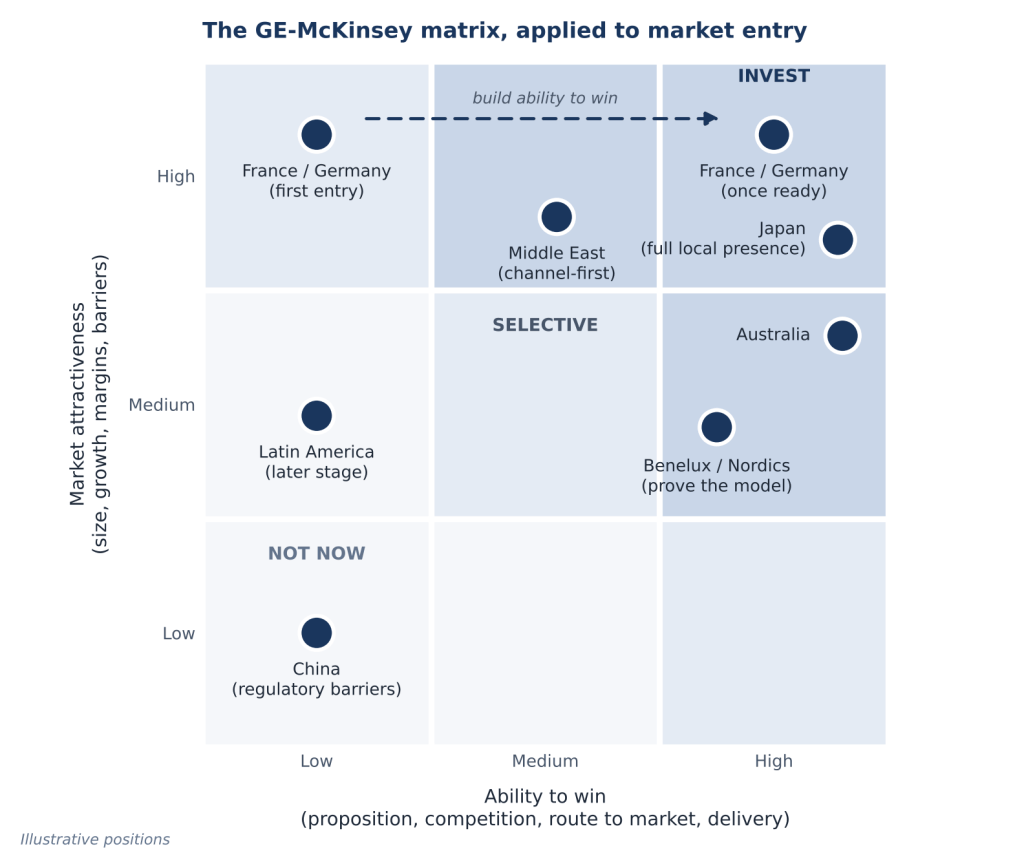
Strong on both axes: invest.
Strong on one, weak on the other: enter selectively, in stages or through partners.
Weak on both: not now.


Leave a Reply